Importance of Donation on Akshaya Tritiya 2026
Beyond Gold: Why Akshaya Daan Is the Most Powerful Ritual You Can Do This Akshaya Tritiya

Introduction
Every year on Akshaya Tritiya, India's jewellery stores open before dawn and queues stretch around the block. Gold is bought, celebrated, and displayed. But the oldest scriptures that speak of this day - the Bhavishya Purana, the Skanda Purana, texts that have shaped how this festival has been observed for centuries - barely mention gold at all. What they return to, repeatedly and with certainty, is the importance of donation on Akshaya Tritiya. The verse is unambiguous: Akshaya Tritiyaaya daanam, punyam cha na kshiyate - the merit of charity given on this day never diminishes. The word Akshaya itself means that which never ends. Akshaya Tritiya 2026 falls on Sunday, 19 April, and the entire day is an Abujh Muhurat - sacred without needing a separate auspicious timing. In this blog, you will learn what makes Akshaya Daan different from ordinary giving, the five items the scriptures specifically recommend donating, the Sudama story that explains the spiritual mechanics of it all, and how a small act of daan on this one day can generate merit that lasts far longer than any investment.
What Makes Akshaya Daan Different From Regular Charity

Charity has always been sacred in Hinduism - daana is one of the three foundational paths of dharma alongside tapa (austerity) and yajna (ritual offering). But Akshaya Tritiya occupies a category entirely its own.
According to the Skanda Purana, any virtuous action performed on Vaishakh Shukla Tritiya - japa, havan, pitra-tarpan, or charity - yields fruit that is eternal. It is one of only three days in the entire Hindu calendar considered a Swayam Siddha Muhurat - a self-auspicious moment that needs no external validation from a panchang or an astrologer. The other two are Yugadi (Hindu New Year) and Vijaya Dashami. On every other day, the merit of your giving depends on the quality of your timing, place, and intention. On Akshaya Tritiya, the timing has already been arranged on your behalf.
The Bhavishya Purana goes further still: giving on this day does not diminish your wealth - it multiplies it. Not as a transaction, but as a consequence of aligning yourself with the very force that generates abundance. Akshaya Daan is not philanthropy with spiritual benefits. It is a cosmic act with a cosmic return.
5 Sacred Items to Donate on Akshaya Tritiya - And Why Each One Matters
1. Annadanam - Feeding the Poor on Akshaya Tritiya
Annadanam param daanam - food is the supreme gift. This is not sentiment. The scriptures hold that feeding the poor on Akshaya Tritiya is equivalent to serving Lord Narayana himself - because the body is the vessel through which the soul inhabits the world, and nourishing that body, especially in the scorching Vaishakh heat, is to serve the divine in its most immediate form.
You do not need to organise a large langar. One meal, given with genuine intention to someone who truly needs it, carries the full weight of Annadanam. Scale matters less than sincerity.
2. Water in an Earthen Pot - Jal Daan
Jal Daan - donating water in a clay kumbha - holds specific scriptural significance on a day that falls in the peak of Indian summer. The scriptures state that offering cool water to a thirsty person on Akshaya Tritiya satisfies the souls of ancestors in the afterlife. The earthen pot is not incidental: clay naturally cools the water, and the vessel itself is an ancient symbol of earth's generosity. Placing one outside your home or at a street corner on 19 April is one of the simplest, most complete acts of daan in existence.
3. Sattu and Jaggery - Summer Nourishment
Roasted gram flour (sattu) and jaggery (gur) have been donated on Akshaya Tritiya since the Vedic period. Both are cooling, sustaining foods for the summer season - practical and sacred in the same gesture. The Bhavishya Purana specifically names sattu as an ideal daan item for Vaishakh, because it meets an immediate, seasonal human need. Giving what a person actually requires, at the moment they require it, is the heart of dharmic charity.
4. Clothes and Footwear
Donating cloth - particularly white or saffron fabric - to a Brahmin, a sadhu, or a person in genuine need is considered highly meritorious. Footwear holds equal weight in the Vaishakh heat, when many people walk barefoot on scorching roads. The spiritual logic here is consistent across every category of Akshaya Daan: relieve suffering in the physical world, and the punya accrues in a form that does not decay.
5. Fruits, Grains, and Household Essentials
The Skanda Purana names mango, sugarcane, and seasonal fruits as particularly auspicious donations on this day. Donating dry grains - rice, dal, wheat - extends the nourishment of Annadanam across multiple meals, multiplying the merit with each one. A bag of grain left with a family in your neighbourhood, or contributed to a local food bank, is the direct modern equivalent of what the Puranas describe.
The Story That Explains Everything - Krishna and Sudama

No story in Hindu tradition explains the Akshaya Daan benefits more completely than the meeting of Lord Krishna and Sudama.
Sudama was a Brahmin scholar - brilliant, devoted, and desperately poor. His wife finally persuaded him to visit his old friend Krishna, now the king of Dwarka. He arrived with nothing but a small cloth bundle of pohe (flattened rice) - so humble a gift that he was embarrassed to hand it over. Krishna, who saw and knew everything, snatched it from Sudama's hands before he could hide it, and ate it with more obvious joy than he showed at any royal feast.
Sudama went home having asked for nothing and received nothing visible. He had only given - his friendship, his presence, his small bundle of rice offered with complete love and zero calculation. When he reached home, his mud hut had become a palace.
The Bhagavata Purana does not describe this as a miracle. It describes it as the law of Akshaya Daan working as it was designed to. Give without calculation. Give what you have. Give on the day when the universe is aligned to amplify every act of dharma. The return is not payment. It is resonance.
How to Set Up a Sacred Space for Giving This Akshaya Tritiya

Akshaya Daan does not require a temple or a pandit. It requires intention, a clean space, and what you already have.
Before you give, go to your home mandir. Light a diya. Offer a flower. Recite your intention aloud - I offer this in the name of Akshaya Dharma. Hindu scripture is clear that giving with conscious sankalpa (intention) multiplies the spiritual merit of the act. The same meal, given with clarity of purpose rather than habit, carries more punya than its equivalent given distractedly.
Then prepare what you will donate - a cooked meal, a filled earthen pot, a bag of grain, a pair of slippers. One genuine offering carries more weight than ten rushed ones.
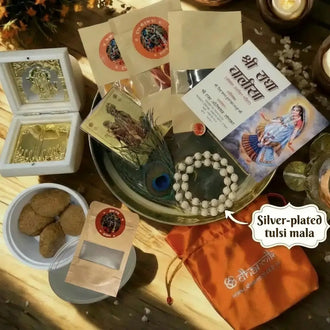
Before the act of giving, placing a sacred item at your mandir as an invocation of Akshaya abundance is a tradition observed across India. The Ram Amrit Silver Coin - gold-plated and blessed - is placed at the home puja space as a symbol of divine prosperity before and after the daan. The Krishna Darbar - gold-plated and sourced from a sacred dham - brings the presence of the Lord whose generosity this festival most closely reflects.
Read Also: Deciding between a Tulsi mala and Rudraksha for daily wear? This helps
The "Akshaya" in Akshaya Daan - Why This Karma Never Fades
Most karma, in Hindu philosophy, is time-bound. A good deed done half-heartedly or during an inauspicious period earns merit that naturally dissipates. The Skanda Purana's promise about Akshaya Tritiya is unusual precisely because it says the opposite: punyam cha na kshiyate - the merit does not diminish. It remains.
This is the scriptural merit of charity on this day - not about scale, but about permanence. A meal donated on an ordinary day eventually exhausts its karmic fruit. The same meal, with the same intention, given on Akshaya Tritiya does not. It continues to generate merit across lifetimes.
This is also why the Bhavishya Purana emphasises the quality of intention behind every act of Akshaya Daan. The cosmic timing is already on your side. What you bring to it - sincerity, care, the willingness to give without calculating the return - determines the depth and duration of what that permanent merit does for you.
For those whose daily life includes puja, a sacred item installed on this day carries a similar quality of permanence. The Krishna Murti Gold Plated placed at your home mandir on Akshaya Tritiya becomes an enduring anchor of that day's devotion - something you return to, every morning, with the memory of what you chose to give.
Read Also: Before choosing any sacred item for daily wear or your mandir, here is how to identify a genuine one

The Ram Amrit Golden Coin and the Krishna ji Charan Gold Plated placed at your mandir on Akshaya Tritiya are not merely decorative. In devotional tradition, installing a sacred murti or coin on this day is itself a form of Akshaya Daan - an offering to the divine whose merit, like everything given on this day, does not diminish.
Frequently Asked Questions
Q: What is the importance of donation on Akshaya Tritiya?
The Skanda Purana states that charity on Akshaya Tritiya earns akshaya punya - merit that never diminishes. Unlike ordinary good deeds, Akshaya Daan benefits are described as eternal. The entire day is a Swayam Siddha Muhurat - no separate timing needed - making every act of giving inherently and permanently auspicious.
Q: What to donate on Akha Teej?
The Bhavishya Purana recommends five specific items: food (Annadanam), water in an earthen pot (Jal Daan), sattu and jaggery, clothing and footwear, and seasonal fruits or dry grains. Each addresses an immediate human need in the Vaishakh heat and carries specific scriptural merit when given with genuine intention.
Q: What is Annadanam and why is it significant on Akshaya Tritiya?
Annadanam means the donation of food - Annadanam param daanam, the supreme gift. On Akshaya Tritiya, feeding the poor is considered equivalent to serving Lord Narayana himself. The merit earned is permanent, not time-bound, making it the highest act of giving on the most auspicious day of the year.
Q: What is the spiritual benefit of donating water in earthen pots on Akshaya Tritiya?
Jal Daan - offering water in a clay kumbha - on Akshaya Tritiya is believed to satisfy the souls of ancestors in the afterlife. Earthen pots naturally cool the water and symbolise earth's generosity. Placing a filled pot outside your home on 19 April is a simple, complete act of ancient daan.
Q: Does placing a sacred murti at the home mandir count as Akshaya Daan?
Yes. Installing a sacred murti, coin, or blessed item at a home mandir on Akshaya Tritiya is itself considered daan - an offering made directly to the divine. The merit attached follows the same Akshaya principle: it does not diminish with time, across this life or the next.
Conclusion
Most people leave Akshaya Tritiya with something in their hands - a gold coin, a piece of jewellery, a digital wallet receipt. That is not wrong. But the scriptures have always been clear about which act on this day carries the deepest weight.
Akshaya Tritiyaaya daanam, punyam cha na kshiyate. Charity given on this day earns merit that does not end. Not merit that lasts a season. Not merit that fades when the occasion passes. Merit that stays - carried forward across this life and beyond it.
The Sudama story does not survive every retelling of the Bhagavata Purana because it is emotionally satisfying. It survives because it describes a law: give without calculation, give what you have, give on the day when every act of dharma is cosmically amplified - and what you gave will not have reduced you. It will have returned.
On 19 April 2026, before you open any investment app, before you check gold rates, take a few minutes for an act of Akshaya Daan. A warm meal. A filled earthen pot. A bag of grain left at a neighbour's door. A coin placed at your mandir with a genuine prayer and a clear intention.
Then bring the Lord's blessing into your space. The Ram Amrit Silver Coin and Krishna Darbar installed after an act of Akshaya Daan rest on the most auspicious ground there is. Explore the full range of gold-plated sacred items from Dharmik's Home Mandir Essentials - blessed from India's dhams, free shipping across India.
Written by Nayan Khetawat, Dharmik