Govardhan Puja 2026: City Muhurat, Samagri Bhog List

Govardhan Puja 2026 falls on Tuesday, November 10. The date is fixed by the sunrise-confirmed Tithi, the lunar day that decides when the festival is observed.
Online searches throw up three different dates for this year: October 30, November 9, and November 10. That mix-up leads some people to shape the cow-dung mound, worship the cow, and lay out the thali on the wrong day. Others get the date right but miss the Pratahkala window, the morning period that closes before 9 AM in most cities.
This piece confirms the date and gives the muhurat city by city. It also lists what to gather before the rites begin: the mound, the cow worship items, the thali, and the Annakut bhog.
TL;DR
- Govardhan Puja 2026 falls on Tuesday, November 10, confirmed by Kartik Shukla Pratipada, the sunrise-based Tithi that fixes the date every year.
- Check your own city's Pratahkala muhurat before you start the mound. The morning window moves with local sunrise and can differ by nearly 25 minutes between cities.
- If the morning window passes, shift to the evening Sayankala slot instead of waiting a day, but start before or after Rahu Kaal in the mid-afternoon.
- Gather samagri in three groups ahead of time, the mound and bhog items, the cow-worship items, and the puja thali, so nothing sends you out searching once the muhurat opens.
Govardhan Puja 2026 Date: Nov 10, Two Days After Diwali
The date rests on a single calculation. That calculation is Kartik Shukla Pratipada, the first day of the bright half of the Kartik month [1]. Panchang sources that calculate this independently of each other, including Astro Zindagi and AstroSage, land on the same day [1]. Diwali's Lakshmi Puja falls on Sunday, November 8, and the Amavasya tithi runs into the morning of November 9, so Pratipada first holds at sunrise on November 10. That's why November 10 is the date to plan around. And if you've got a date saved from a WhatsApp forward or last year's calendar, this is the one to replace it with.
Govardhan Puja Muhurat by City, Evening & Rahu Kaal
Govardhan puja ka muhurat for November 10 sits inside a narrow morning band known as the Pratahkala window. The exact minutes move with your city's own sunrise. A time copied from a Delhi post can run wrong by half an hour if you're sitting in Bengaluru.
| City | Pratahkala Muhurat (Morning Window) |
|---|---|
| New Delhi | 06:39 AM-08:49 AM |
| Bengaluru | 06:16 AM-08:35 AM |
That gap between the two cities is almost 25 minutes. It isn't two astrologers disagreeing with each other. Panchang calculations treat the Pratahkala window as the first fifth of daylight after sunrise, not a fixed clock time. Bengaluru's sun simply rises earlier than Delhi's. A family in Bengaluru starting the puja at 6:39 AM, Delhi's opening time, would already be 23 minutes into their own window rather than at the start of it. Use the govardhan puja shubh muhurat calculated for your own city. If yours isn't one of the two listed here, any panchang site with a city selector will give you the matching window in a minute or two.
If the morning passes before you're ready, nothing is lost. Panchang guidance for 2026 allows the ritual to move to the late afternoon on the same day. Delhi's own listings carry a Sayankala window of 3:20 PM to 5:30 PM, the alternative. One stretch to avoid, whichever slot you use, is Rahu Kaal, a daily period Hindu timing guides flag against starting anything important. On November 10, 2026, it runs from 2:49 PM to 4:10 PM [1], cutting straight across the evening fallback. Begin before 2:49 PM, or wait until after 4:10 PM.

Govardhan Puja Katha: Why Krishna Lifted the Hill
This katha, a sacred story drawn from the Bhagavata Purana, centers on Krishna as a seven-year-old growing up in Vrindavan. The cowherd community there performed an annual yajna to Indra, king of the gods and controller of the monsoon. They believed their harvest depended entirely on his favor [2]. Krishna thought the lavish offerings were unfair to farmers who had little to spare. He told his father, Nanda Maharaja, that their real debt was to Govardhan Hill itself, to its grass, water, and pasture. It was not a debt owed to a god living far away in the clouds. Young as he was, his argument carried enough weight that the villagers cancelled the yajna outright and turned their worship toward the hill instead [2].
Indra took the slight personally. He sent a storm built to wipe out the village, its people, and its cattle in one stroke [2]. Picture the scene: thunder cracking over a cluster of mud huts, cattle bawling in the open, and children pulled close by mothers. They had never seen rain like this. Krishna's response was to lift the entire hill on the little finger of his left hand and hold it aloft like an umbrella, calling every villager, every family, and every cow to shelter beneath it [2]. The rain did not let up for days. Krishna stood there the whole time without any visible strain, the hill balanced on one finger as if it weighed nothing at all.
Indra eventually understood that no ordinary being could do what he was watching. He came down from the heavens to beg Krishna's forgiveness [2]. Krishna then took the form of the mountain himself and accepted the villagers' offerings as a giriyajna, literally a mountain of food. That food was offered to the hill. That single moment is the reason the puja asks you to build a small hill of food today. You do not simply light a lamp and move on [3].
Govardhan Puja Samagri List: Mound, Thali and Bhog
With the story settled, group everything you need to gather into three categories: materials for the mound, items for the cow and cowherd worship, and the thali you set in front of the Govardhan picture or idol. Pull all three together the evening before, if you can. Think of it like laying out ingredients before a big meal. The first rite begins the moment the muhurat window opens, and there is no good time to run to a shop.
For the mound itself, keep cow dung ready to shape Giriraj Maharaj. You also need sugarcane sticks, mango leaves, a coconut, camphor, roli, akshat (unbroken rice), a water-filled kalash, Gangajal, ghee, a flower garland, a clay diya, and a silver coin. Curd, raw milk, honey, and mishri go on afterward as panchamrit, the five-ingredient mixture that turns a dung shape into a consecrated one [4]. This happens once the mound is built. The morning cow worship needs its own small set, kept separate from the mound materials: roli, rice, flowers, water, a mauli thread, curd, and a lit oil lamp. You use this set after the morning bath, to honor the cow and the cowherd boys.
The thali for the Govardhan picture carries the most items of all. It includes roli, rice, batashe, dhoop, an oil lamp, a water-filled kalash, kesar, naivedya, mithai, Gangajal, paan, flowers, curd, honey, a flower garland, and kheer. Several items, including roli, Gangajal, and flowers, show up in more than one group. That repetition isn't an error in the list. Each stage calls for its own fresh offering, not one shared pile. So don't assume you can set aside a single batch of flowers for the whole morning.

Annakut Bhog: What the 56 Dishes Actually Mean
Annakut literally means a heap of grain, or a mountain of food. The bhog offering turns the Govardhan mound into an actual pile of food rather than a symbolic one. It's popularly called Chhappan Bhog, 56 delicacies, and the number comes straight from the story you just read. Krishna is said to have eaten eight meals a day. He went without food for the seven days he held up the hill. So when the rains finally stopped, villagers prepared 56 dishes, eight for each day missed, to make up every meal he had gone without.
Fifty-six is a loving tradition rather than a rule. A home Annakut of eight, eleven, or twenty-one dishes made with care counts just as much. Don't let the number talk you out of doing it at all, even if you're cooking for a family of four rather than feeding a temple hall.
A handful of dishes show up across most home accounts of the day. Kadhi-chawal is named most often as the signature dish, usually served alongside panchamrit and makhan-mishri, butter mixed with sugar [4]. A mixed-vegetable sabzi, made from whatever seasonal vegetables are already in the kitchen, rounds out the spread alongside rice shaped into a small hill on the plate. The meal is offered to Krishna before anyone else eats, so it's cooked without onion or garlic. That's the same rule many households already follow on other festival days. Think of it less as a single serving and more as a family meal scaled up: someone deciding which vegetables go into the sabzi, a child carrying bowls to the mound, the kitchen busier than usual for a few hours before the aarti.
The full spread doesn't have to land inside the muhurat window itself. Many families offer a smaller version during the morning rite. They save the larger many-dish Annakut for a weekend later in the month, when the whole extended family can actually sit down together.
Govardhan Puja Vidhi: Make the Mound and Worship the Cow
With the samagri gathered, the vidhi itself starts with two jobs before the hill rite proper. You shape the mound, and you honor the cow.
Build the Govardhan mound from cow dung, sometimes mixed with clay. Decorate it with flowers, diyas, rangoli, and small figures of Krishna, cows, and peacocks. If you live in a flat with no cow dung handy, you have workable alternatives: a mound of cooked rice or sweets on a thali, clean clay or garden soil topped with durva grass and flowers, a rangoli outline of the hill traced in flower petals, or a Krishna murti set on a raised mound of cloth and flowers. A family on the ninth floor of a Pune apartment block might trace the hill in petals on the balcony floor instead of shaping dung. The ritual carries exactly as much weight. None of these is a lesser version; they're simply the shape the mound takes when cow dung isn't within reach.
You worship cows and bullocks in full before the hill rite begins. You bathe them, decorate them with flowers, kumkum, and colorful cloth, and feed them jaggery and fresh grass. If you don't keep a cow at home, donating to a gaushala carries the same merit, and placing a small cow figurine beside the Krishna idol in your home mandir works just as well.
Govardhan Puja Vidhi: Parikrama, Aarti and Prasad
The family builds the mound and honors the cow. Then they circle the hill, usually seven clockwise circuits, before the aarti begins [4]. Traditionally, the men of the household lead this part of the ritual, carrying the water pot or guiding the circuit [4]. In most homes today, though, everyone takes a turn. Some households add the mantra "Shri Giriraj Dharane Namah" while walking, meaning I bow to the one who holds the Giriraj mountain [1]. This home version stays modest next to the real pilgrimage: devotees circle the actual Govardhan hill near Mathura on a route of roughly 21 kilometres, and many of them walk the whole way barefoot.
The aarti itself follows a familiar shape. The family lights diyas and incense, then waves the lamp in slow circular motions while singing the Govardhan Aarti. The family offers whatever is cooked that day, Annakut dishes included, to the mound first. They share it afterward as prasad. That sharing extends well past the household: in Mathura and Vrindavan, temples distribute the same prasad to thousands of visitors [4]. Most families at home pass a share to neighbors too, before anyone sits down to eat.
A Simple Remedy That Carries Into the Year
One simple remedy often goes with the day, and it costs nothing beyond what you've already cooked. Keep a pinch of the Annakut prasad in your grain container afterward, a small token meant to carry the year's food supply forward [1]. Many households already do this without thinking of it as a separate ritual. They fold it into the end of the day's cooking, rather than treating it as one more step on a list. It's a small gesture. But it's the kind that turns a one-day ritual into a year-long habit of noticing where the food comes from.
What to Source Before Nov 10
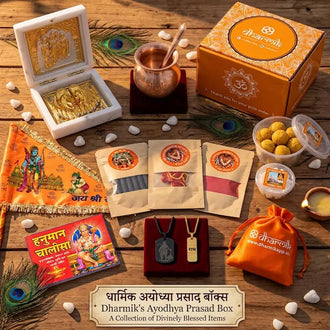
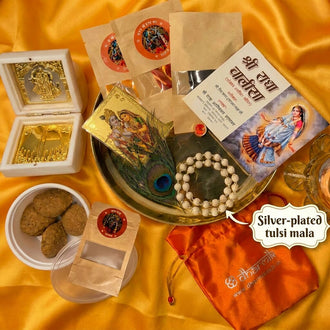
Govardhan Puja 2026 comes down to one date, Tuesday, November 10, confirmed by the sunrise rule and the city muhurat that follows from it. The samagri, the Annakut spread, and the vidhi are now sorted into an order you can actually follow on the day itself. Puja items from a source you can actually trust are harder to find locally than from a stall that can't tell you where its brass came from. At Dharmik, we source mandir decor, rudraksha, and puja essentials directly from Vrindavan and Haridwar. Each piece is blessed before it ships. For this Govardhan Puja, start with the samagri list above, then browse our spiritual products collection for pieces blessed before they reach your mandir.
Frequently asked questions
What time is Govardhan Puja in 2026?
In most cities, the morning window falls somewhere between 6:16 AM and 8:49 AM on November 10, with the exact minutes depending on your city's sunrise. Check a panchang for your own location. Don't borrow a time listed for somewhere else.
Can we do Govardhan Puja at home?
Yes, and most families do exactly that. Shape the mound from cow dung, clay, rice, or a flower rangoli, then worship your own cow if you keep one. If you don't, donate to a gaushala.
What food is offered during Govardhan Puja?
The main offering is Annakut, built around kadhi-chawal and a mixed-vegetable sabzi. Sweets and fruit round out the spread. Everything is cooked without onion or garlic, since Krishna is served the meal first.
What happens if I miss the morning muhurat for Govardhan Puja?
Nothing is lost. Move to the evening Sayankala window instead, roughly 3:20 PM to 5:30 PM in Delhi, but avoid starting the puja during Rahu Kaal. Rahu Kaal runs from 2:49 PM to 4:10 PM.
What is Bhai Dooj and when does it fall in 2026?
Bhai Dooj is the day sisters pray for their brothers' long life, and in most panchangs it falls on the day right after Govardhan Puja, Wednesday, November 11, 2026. Some list November 10, so check your local panchang.